
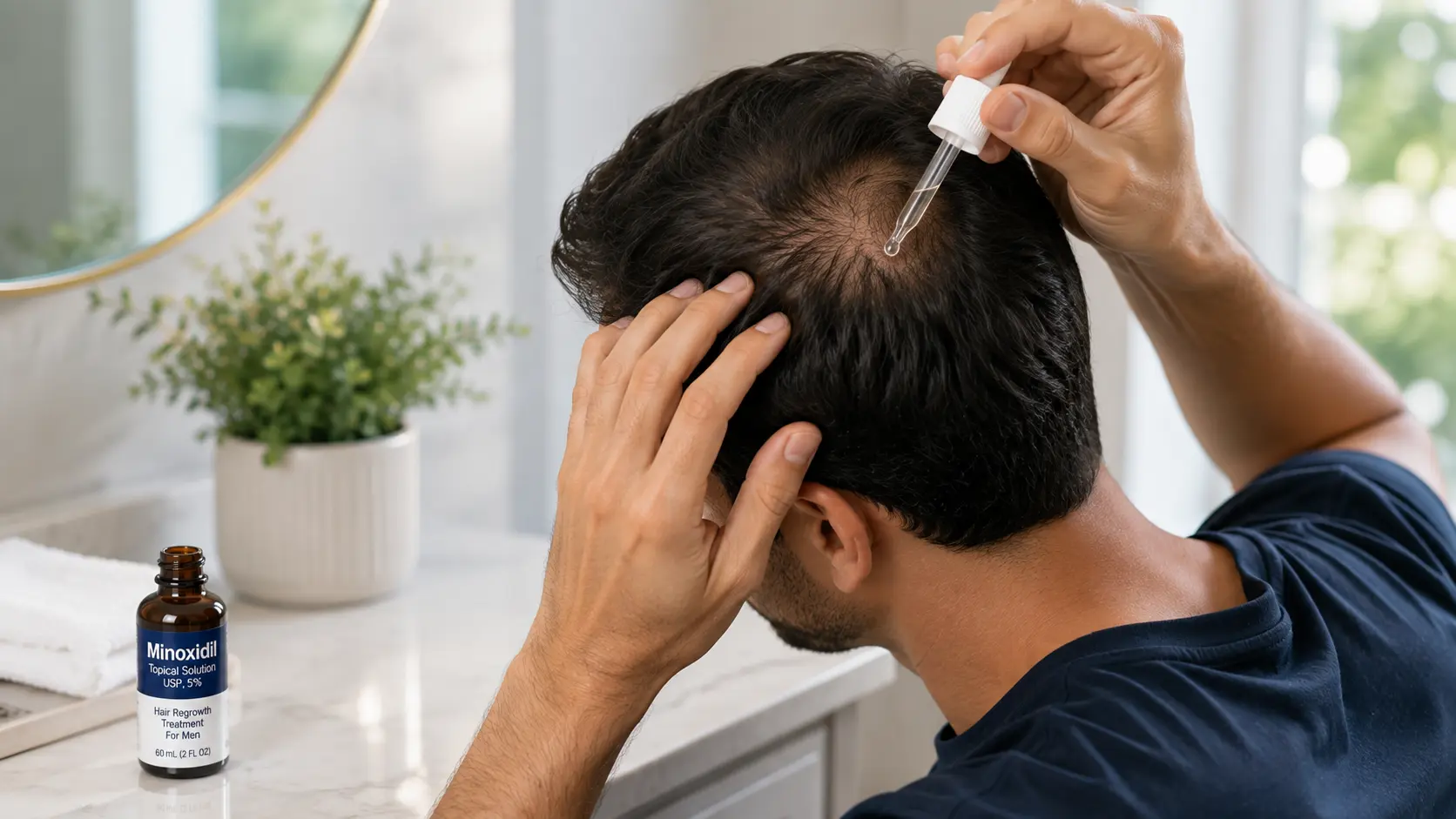
If you are researching options for thinning hair or hair loss, minoxidil has likely come up. It is one of the most studied and widely available treatments for hair loss, and it is the only topical ingredient approved by the U.S. Food and Drug Administration (FDA) for androgenetic alopecia, the most common cause of hair thinning in both men and women. This article explains how minoxidil works, what the evidence says about its effectiveness, what side effects can occur, and when it makes sense to talk with a healthcare professional before starting treatment.
What Is Minoxidil?
Minoxidil was originally developed decades ago as an oral medication for high blood pressure. Researchers noticed that people taking it often grew extra hair as a side effect, which led to the development of a topical version specifically for hair loss. Today, topical minoxidil is available over the counter in liquid and foam formulations, typically in 2% or 5% strengths. A low-dose oral form of minoxidil is also sometimes prescribed off-label by healthcare professionals for hair loss, though this use requires medical supervision.
How Does Minoxidil Work for Hair Growth?
The exact mechanism is not fully understood, but research suggests minoxidil works through several combined effects rather than a single pathway. It is thought to widen blood vessels around hair follicles, which may improve blood flow and the delivery of oxygen and nutrients to the scalp. Minoxidil also appears to prolong the growth (anagen) phase of the hair cycle and may influence certain growth-factor and cell-signaling pathways involved in follicle activity. It is not a hormonal treatment and does not work by blocking androgens, which is one reason it is approved for use in both men and women.
Talk to a Doctor
Get Answers to Your Health Questions
Connect with health professionals — anytime, from anywhere.
Talk to a Doctor
Get Answers to Your Health Questions
Connect with health professionals — anytime, from anywhere.
Who Might Consider Using Minoxidil?
Minoxidil is most used for androgenetic alopecia, also known as male-pattern or female-pattern hair loss, a common and largely genetic condition. It may also be used off label for certain other types of hair thinning, depending on an individual's diagnosis. Because hair loss can have many different causes, including thyroid conditions, nutritional deficiencies, stress, certain medications, and autoimmune conditions, a healthcare professional or dermatologist can help determine whether minoxidil is an appropriate option for a specific situation, or whether the underlying cause needs to be addressed first.
How Effective Is Minoxidil for Hair Regrowth?
What Clinical Research Shows
Clinical trials of 5% topical minoxidil have consistently shown increases in hair count compared with a placebo. In studies of 5% minoxidil used over roughly 16 weeks, research suggests approximately 30 to 40 percent of users experience visible regrowth, while other users may see stabilization of hair loss rather than significant new growth, and a smaller group may see little change. Results vary from person to person, and minoxidil does not work the same way, or to the same degree, for everyone.
Factors That May Affect Individual Results
Response to minoxidil can depend on several factors, including how long hair has been thinning, the extent of hair loss, individual differences in an enzyme that helps activate minoxidil in the scalp, and consistency of use. Longer-standing hair loss with significant follicle miniaturization tends to respond less predictably than earlier-stage thinning.
- Duration and severity of hair loss before starting treatment
- Consistency of daily application
- Individual biological variation in how the scalp processes minoxidil
- Whether an underlying medical cause of hair loss has been identified and addressed
How Long Does It Take to See Results?
Hair growth is a slow process, and minoxidil is not a fast fix. Many people notice increased shedding in the first several weeks of use, which reflects the hair cycle resetting and is generally considered a normal, temporary response rather than a sign the product is not working. Visible improvement in hair density typically takes around 3 to 4 months of consistent daily use, and it may take 6 months or longer to assess whether minoxidil is working well for a given individual. If there is no noticeable change after about 4 months, it is reasonable to check in with a healthcare professional to reassess the approach.
Potential Side Effects of Minoxidil
Common, Mild Side Effects
The most frequently reported side effect of topical minoxidil is scalp irritation, which can include dryness, redness, itching, or flaking, especially with solutions that contain propylene glycol. Foam formulations may cause less irritation for some users. Unwanted hair growth on nearby skin, such as the forehead or face, can also occur, particularly if the product spreads beyond the intended area.
Less Common but More Serious Side Effects
Although topical minoxidil is absorbed into the body only in small amounts, some users report effects such as a rapid or irregular heartbeat, dizziness, or swelling of the hands, feet, or face. Oral minoxidil, because it affects the whole body, carries a higher likelihood of effects such as fluid retention, low blood pressure, and changes in heart rate, and it is generally used only under medical supervision. Anyone who experiences chest pain, fainting, sudden swelling, or a significantly fast or irregular heartbeat while using minoxidil in any form should seek medical attention.
Supporting Your Scalp: Shampoo and Hair Care Considerations
Because minoxidil can be drying to the scalp, some people look for a gentle, sulfate-free option when choosing the best shampoo for thinning hair to use alongside treatment. A mild, non-stripping shampoo can help reduce irritation and flaking without interfering with minoxidil's action, since minoxidil needs to remain on the scalp for several hours to be absorbed. There is no specific shampoo that is proven to regrow hair on its own, and shampoos marketed for thinning hair should be viewed as a supportive part of a routine rather than a replacement for evidence-based treatment.
What Happens If You Stop Using Minoxidil?
Minoxidil works only while it is being used consistently. If treatment is stopped, any hair that grew as a result of minoxidil is generally shed within a few months, and the underlying pattern of hair loss typically continues on its previous course. This is an important consideration when deciding whether to start minoxidil, since it is usually intended as a long-term, ongoing treatment rather than a one-time course.
When Should You See a Healthcare Professional?
It is a good idea to speak with a doctor or dermatologist before starting minoxidil, and especially in the situations below, since a professional can confirm the cause of hair loss and check whether minoxidil, or another approach, is appropriate.
- Hair loss is sudden, patchy, or accompanied by scalp pain, redness, or scarring
- There are signs of an underlying condition, such as significant fatigue, weight changes, or irregular periods
- You are pregnant, breastfeeding, or trying to conceive
- You have a history of heart or kidney disease and are considering oral minoxidil
- You have used topical minoxidil consistently for 4 to 6 months without any noticeable improvement
- You experience side effects such as chest discomfort, rapid heartbeat, or swelling
Frequently Asked Questions
Can minoxidil really regrow hair?
For many people with androgenetic alopecia, minoxidil can help regrow some hair and slow further thinning, and clinical research supports its effectiveness compared with a placebo. However, it does not work for everyone, results vary in degree, and it tends to work best on areas with follicles that are thinning rather than on scalp where hair loss is already advanced or where follicles are no longer active. It is not a guaranteed cure, and outcomes should be discussed with a healthcare professional based on individual circumstances.
What are the side effects of minoxidil?
The most common side effects of topical minoxidil are scalp irritation, dryness, and unwanted hair growth on nearby skin. Less commonly, some people notice a fast or irregular heartbeat, dizziness, or swelling, which can indicate the medication is being absorbed more than intended and should be evaluated by a doctor. Oral minoxidil, used off label at low doses, has a higher chance of affecting heart rate and fluid balance and requires closer medical monitoring.
Conclusion
Minoxidil remains one of the most researched and widely used treatments for common hair thinning, with evidence supporting its ability to help many people regrow hair or slow further loss. That said, it is not effective for everyone, requires ongoing use to maintain results, and can cause side effects that range from mild scalp irritation to, less commonly, effects on heart rate and fluid balance. Before starting minoxidil, or if hair loss is sudden, patchy, or accompanied by other symptoms, it is worth speaking with a healthcare professional or dermatologist to confirm the cause of hair loss and decide whether minoxidil, another treatment, or a combination approach is the right fit.
References
Mayo Clinic. Minoxidil (topical route) — Side effects & dosage. https://www.mayoclinic.org/drugs-supplements/minoxidil-topical-route/description/drg-20068750
Mayo Clinic. Minoxidil (oral route) — Side effects & dosage. https://www.mayoclinic.org/drugs-supplements/minoxidil-oral-route/description/drg-20068757
PubMed. Minoxidil: a comprehensive review. https://pubmed.ncbi.nlm.nih.gov/34159872/
International Society of Hair Restoration Surgery (ISHRS). Minoxidil: Formulation, Dosage & Side Effects. https://ishrs.org/patients/treatments-for-hair-loss/medications/minoxidil/