
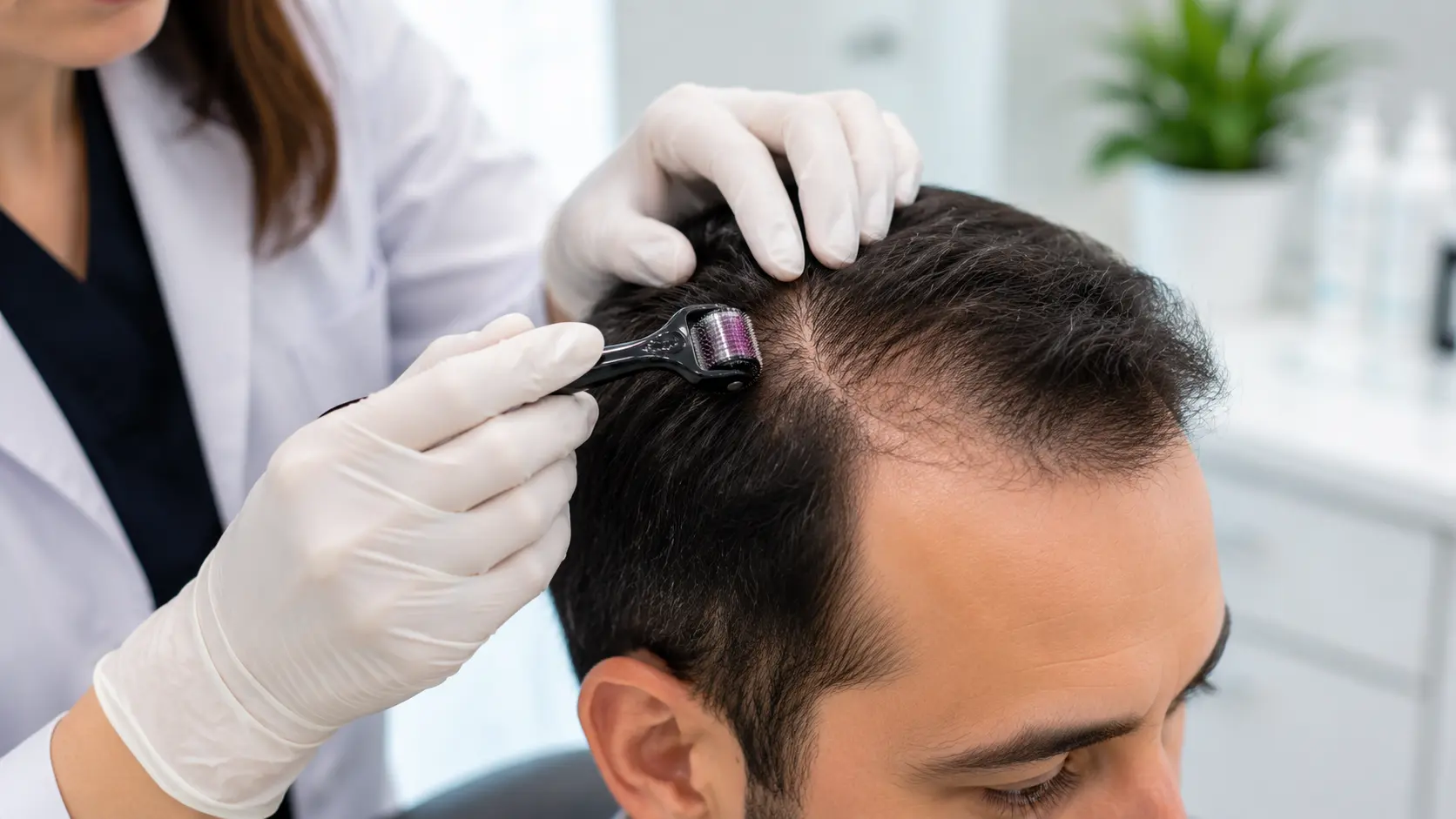
Derma rollers, small handheld tools covered in tiny needles, have become a popular at-home tool for hair loss, usually marketed alongside topical minoxidil. There's real research behind this combination, more than for most hair growth trends, but it's worth understanding exactly what that research shows, and doesn't show, before adding one to your routine.
What Is a Derma Roller and How Is It Supposed to Work?
A derma roller is a handheld device covered in very fine needles, typically ranging from about 0.25 to 1.5 millimeters in length, that creates tiny, controlled punctures in the skin when rolled across the scalp, a process called microneedling. This is thought to help hair growth in two ways: first, it triggers a wound-healing response that releases growth factors, including platelet-derived growth factor and vascular endothelial growth factor, which can help nudge follicles from a resting state into active growth. Second, and this is where most of the strongest evidence lies, the micro-injuries appear to significantly increase how well topical medications like minoxidil absorb into the scalp; one study measuring drug delivery found microneedling increased absorption several-fold compared to intact skin.
Do Derma Rollers Actually Work for Hair Growth?
The evidence is more promising when a derma roller is used alongside minoxidil than when it's used on its own. A 2025 systematic review and meta-analysis of eleven randomized controlled trials, involving over 600 people with androgenetic alopecia, found that combining microneedling with minoxidil significantly improved hair count compared to minoxidil alone. This builds on earlier, smaller trials, including a frequently cited 2013 study of 100 men that found significantly greater improvement in hair count at 12 weeks in the group using weekly microneedling alongside daily minoxidil, compared to minoxidil alone. Standalone microneedling, used without minoxidil, has been studied far less, and a 2021 review specifically noted that more research is needed before it can be confidently recommended as an individual therapy on its own.
Talk to a Doctor
Get Answers to Your Health Questions
Connect with health professionals — anytime, from anywhere.
Talk to a Doctor
Get Answers to Your Health Questions
Connect with health professionals — anytime, from anywhere.
Is Dermarolling Good for Your Hair?
Used appropriately and as a complement to an established treatment like minoxidil, current evidence suggests dermarolling is reasonably safe and may meaningfully improve results for people with androgenetic alopecia. It's not a substitute for minoxidil or other evidence-based treatments on its own, and it isn't well studied for other causes of hair loss, such as alopecia areata or telogen effluvium, so it isn't something to reach for as a general hair health tool regardless of cause. Reported side effects in clinical trials have generally been mild, such as temporary redness or minor discomfort, though improper technique or over-use raises the risk of scalp irritation or infection.
How to Use a Derma Roller Safely
- Most studied protocols use a shorter needle length (commonly around 0.5 to 1.5 millimeters for at-home use) rolled over the scalp about once a week, alongside daily topical minoxidil use, rather than daily microneedling.
- Clean the device with rubbing alcohol before and after each use, and avoid sharing a derma roller with anyone else, to reduce infection risk.
- Apply gentle, even pressure rather than pressing hard, since more pressure or a longer needle isn't necessarily more effective and increases the risk of irritation or injury.
- Avoid microneedling over an actively inflamed, infected, or broken scalp, and avoid combining it with other irritating treatments applied the same day.
- If you notice ongoing redness, pain, or signs of infection rather than mild, temporary irritation, stop and consult a dermatologist.
What About Other Hair Loss Causes?
The research on microneedling is specific to androgenetic alopecia, generally alongside minoxidil, so it isn't a well-supported approach for other causes of hair loss like alopecia areata, telogen effluvium, or traction alopecia. Getting an accurate diagnosis first matters, since a treatment studied for one type of hair loss doesn't necessarily transfer to another; see our related guide on baldness for an overview of different hair loss causes and their evidence-based treatments.
When Should You See a Healthcare Professional?
It's worth talking with a dermatologist before starting microneedling, particularly to confirm your hair loss is androgenetic alopecia and appropriate for this approach, and to get guidance on technique and frequency. Our related guide on minoxidil for men covers the medication most commonly paired with microneedling in the research, including its own side effects and how to use it correctly.
Frequently Asked Questions
Do derma rollers actually work for hair growth?
There's meaningful evidence that microneedling with a derma roller, when combined with topical minoxidil, improves hair count more than minoxidil alone, based on multiple randomized controlled trials and a 2025 systematic review and meta-analysis. Evidence for microneedling used entirely on its own, without minoxidil, is much more limited, so it's best understood as a way to potentially enhance an existing evidence-based treatment rather than a standalone solution.
Is dermarolling good for your hair?
Used correctly, as an addition to minoxidil rather than a replacement for it, and with proper hygiene and gentle technique, dermarolling appears to be reasonably safe based on current clinical trials, which have generally reported only mild, temporary side effects like redness. It's specifically studied for androgenetic alopecia rather than other causes of hair loss, and improper use, such as excessive pressure, frequency, or poor device hygiene, can increase the risk of scalp irritation or infection, so following a dermatologist-guided protocol is worthwhile.
Conclusion
Derma rollers have more research behind them than many hair growth trends, particularly when used alongside topical minoxidil for androgenetic alopecia, where multiple clinical trials show a meaningful improvement over minoxidil alone. The evidence is much thinner for microneedling used by itself, and it isn't a well-studied option for other types of hair loss. Used with proper technique and hygiene as a complement to an established treatment, it's a reasonably low-risk addition worth discussing with a dermatologist, particularly one familiar with how it's actually been studied.
References
Archives of Dermatological Research — Evaluating the Efficacy and Safety of Combined Microneedling Therapy Versus Topical Minoxidil in Androgenetic Alopecia: A Systematic Review and Meta-Analysis (2025): https://link.springer.com/article/10.1007/s00403-025-04032-1
Dermatology Reports — Effectiveness and Safety of the Combination Therapy of Micro-Needling and Minoxidil in Androgenetic Alopecia (2024): https://doi.org/10.4081/dr.2024.9945
American Academy of Dermatology — Hair Loss: Diagnosis and Treatment: https://www.aad.org/public/diseases/hair-loss/treatment